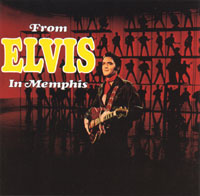
Next year the Rock and Roll Hall of Fame will induct its 25th class of musicians. In honor of this event, Rolling Stone magazine has started a series that looks back at five pivotal albums by Hall of Fame artists, starting with Bruce Springsteen’s The Wild, the Innocent and the E Street Shuffle in Issue 1080. Likewise, I have decided to take a look back at a little Hall history myself, but in a slightly different manner. Beginning with the Class of 1986, I plan to revisit one of my favorite albums by an artist or group from every class. Starting things off is Elvis Presley’s 1969 classic From Elvis in Memphis.
By 1968, Elvis had been performing for some 15 years and had released more than 30 albums; he had changed the face of music and conquered the world. However, his career was in a bit of a lull. While radio was dominated by The Beatles and so-called Hippie music like Jefferson Airplane and the Doors, Elvis spent most of his time making cheesy movies and releasing soundtracks that failed to match the success and quality of his earlier work. But on Dec. 3, 1968, NBC aired Elvis and it became clear that Elvis was back.
Among other things, the special featured stripped down live performances of the star’s early material. Fans were treated to a leather-clad Elvis singing, playing guitar and shaking his hips like he hadn’t done since the ‘50s. With his popularity and confidence restored, Elvis took the energy from the TV special into the studio: the result was From Elvis in Memphis.
Elvis, deciding to take more control of his career, chose to record at the American Sound Studios in Memphis, Tenn. This was the first time he had recorded in Memphis since he left Sun Records in 1955. Since then, the city had become a center for Soul music, and that change can be heard throughout the entire album.
Another important change, besides location, was the addition of producer Chips Moman. As a songwriter, session guitarist and founder of the American Sound Studios, Moman was well-experienced in creating the Memphis soul sound, which involved putting strong, moving vocals (something Elvis had plenty of) in the middle of meticulous arrangements, often done by seasoned session musicians. For this album, Moman had assembled a group who were not only skilled soul players, but were also, like Elvis himself, familiar with country, blues and gospel. From Elvis in Memphis is the mixture of country and R&B that Elvis had pioneered filtered through the soul-pop machine of the Memphis studio.
Many of the songs came from the country music repertoire, such as “It Keeps Right On A-Hurtin,” “Gentle on My Mind” and “I’ll Hold You in My Heart.” But Elvis’ singing makes them fit right in with contemporary soul numbers like “Only the Strong Survive,” bluesy romps like “Power of My Love” and pop songs like “Any Day Now.”
Elvis also included his most explicitly political song to date, “In the Ghetto,” which tells the tale of a young boy’s struggles in the slums of America. Elvis’ gospel-tinged singing—which is undoubtedly strengthened by his own connections to the song, having grown up just above the poverty line himself—gives the song power without turning it into a protest song. It was the first single off the album and reached No. 3 on the Pop Singles chart, his first top ten hit in four years.
The Memphis sessions produced even more hit singles with the non-album tracks such as “Don’t Cry Daddy” and “Kentucky Rain.” But the single biggest song that came out of this period was “Suspicious Minds.” On this soul classic, Elvis’ intensity as he pleads to “not let a good thing die” drives the band towards ecstasy—from the simple opening guitar lick to the full on blast of horns, strings and backing vocals that starts to fade out and then comes back for more. It deservedly gave Elvis his first No. 1 single in seven years.
From Elvis in Memphis was released to wide critical acclaim and has since gone on to be known as one of, if not the best, album of Elvis’ career. In 2003, Rolling Stone named it No. 190 on their list of the 500 Greatest Albums of Rock and Roll. And although he soon sank into the excess and schmaltz that came to define his Vegas Period, this album is a testament to why Elvis Presley was and always will be the King of Rock and Roll.
Sony USA will be releasing a 2-disc Legacy Edition of this album July 28, 2009.
Agreed, very good article. Lots of these tunes are included in my top 200 favorites and this is among my favorite albums. I particularly like I'm Movin' On. I grew up on the Hank Snow version of it but Elvis's version is oh so much better. I think it's the first time I've heard a bass player play lead and I love the bass in this song. Great album and it makes me sorry that the greatness that Elvis rediscovered while recording this was not to last.
Yes, he's got his facts right!
I notice everywhere it states 'Sony USA', plus on amazon.co.uk its listed as an import. Will the new version be realesed in the UK? Brian I know you are the man for this answer!
never change a winning team is as far as I know an Anglo saying, so unfortunately they did
don't know if this had to do with Felton Jarvis or whatever, it was to keep with Chip Moam
Guess he'd have led the artist into his very roots by picking fine stuff to be recorded
a classic album no doubt...arguably his best studio album.I wish they had included suspicious minds on the original lp.he sings with such raw emotion on each song it's just fun to listen to.but i do think other very good if not great lp's get lost in the massive shadow this lp casts...among those being on stage,thats the way it is and the follow up release back in memphis...which could have used kentucky rain and don't cry daddy to give it a boost.from elvis in memphis will always be one of my all-time favs.
I have just received my UK copy from Amazon and can report that it is well worth buying, firstly it's a triple digi-pack with a 20 page booklet with photos and notes also the CD's are in RCA orange from the period and the original sleeves are used throughout and the sound is the best I've heard for these two albums, more bass and smoother highs without using noise reduction, the bonus for me is having the 10 single mono mixes from the period which are so punchy because of radio play, to be honest this item is FTD quality but without being in the 7" format and half the price.
I just got this delivered after pre-ordering it on line and was not that over impressed with the set to be honest!-especially when yu consider the same album is still available for only £6.00 as the single cd version that was released prevoiusly by rca(which also has 7 bonus songs)i really believe they are scrapping the barrell expecting us fans to rush out and purchase the same cd just cos it's been re-titled a 'legacy edition'..Yes,it is a classic Elvis album in its own right,but why re-release it as a double disc set with no unreleased session outtakes and nothing 'new'?/a shame when you consider the previous rca double cd from 1998 'suspicious minds'~the 1969 memphis anthology.(which not only had 43 remastered tracks,but also had 9 previously unreleased alternate versions-aswell as the rare poor mans gold)my advice isget the much cheaper 'single cd' version as its the same album and still got 7 bonus tracks...its saves money!
the sound is great. disc2 back in memphis sounds really good.(ect stranger in my own home town
This two-disc version of ‘From Elvis In Memphis’ collects together the ‘From Elvis In Memphis’ and ‘Back In Memphis’ albums, both of which were derived from Elvis’s celebrated 1969 recording sessions in Memphis. Leftovers and singles taped at those sessions are also included. I won’t appraise the musical merits of these songs because they have been eulogised already by many people. Instead, I’ll address if it’s worth upgrading the previous inclusive Memphis 1969 compilation, the double CD set ‘Suspicious Minds’. Despite my misgivings when this latest project was first announced, it is phenomenally good. The sound is very classy, yet the rawness and emotionality that underpinned the greatness of the original album are somehow enhanced. The overall timbre is crystal clear yet full of warmth. But what tingles the spine the most is the detail now plainly audible in Elvis’ voice – I’ve never before heard him sounding so evocative, so nuanced and so engaged on these recordings. I can think of no other CD set that better illustrates the point that, just as good instruments are useless in isolation, state-of-the-art sound technology only has a value when the engineers operating it are musically adept. The technicians who prepared this new set have truly picked up on the honesty, humanity and simplicity in the music, and have brilliantly brought those key elements to the fore. Closing the final disc with the singles means that the set ends on a run of mostly good songs. Some of the mono single mixes are very distinctive particularly ‘Kentucky Rain’, its ending shorn of overdubbed strings - I’d not heard it in this form since dispensing with the old UK vinyl compilation ‘Hits of the 70s’ half a lifetime ago. The FEIM Legacy Edition doesn’t contain the out-takes found on the ‘Suspicious Minds’ set nor its informal fragments. But this is easily one of the most intelligent and tasteful remastering jobs I have ever heard, the enormity of Elvis’s talent is plain for anyone to hear, and I would urge all his fans to check it out for themselves. His singing is unbelievable.
I dont get the songs in mono. Please tell me why this idea was received postively. It is 2009. If the songs were recorded in stereo (and we know they were) , release them in stereo. This is a nice release and at a good price (an FTD classic version would be over 40.00!) , but the mono songs baffle me. Also the sound is only slightly better on a regular CD player. I've read you need a blu-ray player to really hear the difference. For these reasons, I cannot call this essential, espcially for us older fans.
Dgirl, i agree with you...how can anyone possibly want 10 great singles in mono sound in this day, and age...i'll pass...i'll wait for ftd to release this if i live that long...lol..lol....to each there own, but i have heard enough of the older sound the way it was then, i am 44, and i look forward to newer, fresher, cleaner sound...
I have to agree about the mono songs (and so many!). It baffles me as well. If I want to hear them in mono, I'll break out my 45s or tune into one of the AM oldie stations. I dont want an ultimate 2009 legacy release to include arguably the best songs from these sessions in mono. Amazing decision by the label which makes the whole effort seem fruitless in my opinion. It doesnt even flow right to hear crisp stereo followed by all these songs in mono. Darn, will they ever get it right when it comes to Elvis? Oh wait, they want you to buy the FTD release someday. Ok now I get it.
Well, there's a whole counter (audiophile) argument you should "get"(see other sites) but I won't repeat here because it's boring to re-trace beyond the fact that Elvis originally wanted the distinctive "radio-radio" sound of mono at the time and if nothing else, these are historic versions previously not on CD. I hear (no pun intended) what you all mean but do know that for a lousy 13 bucks on Amazon, you can have the beautiful set (with the best-ever sound thanks to Vic Aneseni) as described so well by Jamie below. The packaging alone is to drool over. It's a no-brainer. I like it so much I'm buying extra copies for friends and my brother. It may be one of the best Elvis releases ever - certainly the original 2 LPs were- now this is the 2009 "go-to" set. And yes, I"m keeping my rarities but this is by and large the "master" set that real fans will turn to for now on.