In our series of email interviews our next victim was a voluntary one, Marc Hendrickx. He's the author of one of the most complete Elvis-fact books available, Elvis A. Presley - Musique et vie d'un Mythe (or Muziek, Mens, Mythe). Unfortunately for the rest of the world this book has only been issued in Dutch and French. His second book about Elvis, which he co-authored with Connie Kirchberg, deals with the lives of both President Nixon and Elvis Presley, and how they both lived "The American Dream". This book is written in English.
Can you tell us a bit about yourself?
About a 100 years ago I started to work in the Belgian book-world, doing all types of production work for others, working with authors, publishers, designers, drawing artists... As a result, I did all kinds of publications, from comics to literature and poetry. I did things like research, lay-out sketching, editorial work and even old-fashioned physical 'cut and paste' work, in the pre-computer era.
Can you tell us something about "Marc the Elvis-fan"?
I was born on the day the Beatles landed in the USA (ed.: 1964), and that must have been a 'sign' of sorts. A counteract so to speak! (laughs). The first two Elvis singles I possessed were Suspicious Minds and Don't Cry Daddy, for which I bugged my family for weeks on end. They all thought I was crazy... A seven year old kid, going on and on about music ?!? When I was about ten years old I started to buy my own singles and LP's, and again Elvis came out on top. But, I didn't have an Elvis time frame so to speak, as I didn't know which music he'd made recently and which was already twenty years old. So, in my local record shop, I started by selecting records going by their cover, asking the manager to play a song or two of the two or three best looking ones, allowing me to make my definite choice on an aural basis.
I finally caught up with the new releases after buying "Hurt", which flopped badly at the time, and "Moody Blue". That single became a big hit, and it was the first one I could really 'follow' in the hitparade and everything. Of course I bought it, and the LP. Then, Elvis died ... When I heard this news I was on holiday with my family and because I was so depressed by the news, my parents decided to go home immediately. A couple of weeks later, with the intention to cheer me up, my father took me to a famous market in Antwerp. But instead of taking my mind off Elvis, he was everywhere... Memorabilia, music, whatever. It turned out to be one hell of a traumatic market experience!
How did you become an Elvis author?
In the mid-eighties, I thought it was strange that there still wasn't a decent Elvis biography out in Dutch or French. Being active in the Belgian bookworld I started looking for an author to propose the idea to, but couldn't find anyone who wanted or could write a 'complete' book the way I imagined it had to be done. So, combining my hobby with my work, the only person able and willing to do it turned out to be... me.
I worked for six years on the project, day and night, traveling all over the world, speaking to all kinds of people. Without already having a publisher, I invested a lot in it, even when disregarding the time and work itself. I bought copyrights for pictures and had plenty of travel expenses. Fortunately it worked out and resulted in a book both heavy in content and in weight. When it hit the market in 1994, both the Dutch and French version sold out in a couple of months.
What else did you write?
After all the time spend on this Elvis project I wanted to do something completely different and wrote a book about animal rights. But I also ended up in the entertainment business again, writing about Fawlty Towers (ed.: the British TV comedy) and translating a Keith Richard biography. Most recently, I entered the sports world, again encountering a major legend, in making a Muhammed Ali biography. He really is one of the very few people on earth to be anywhere near as well-known and popular as my very first topic was.
On the side, I had to update the Presley book for 1998 reprints in Holland and France, plus engage in some BMG projects on Elvis and of course the Nixon/Presley book.
Why was a comprehensive piece of work like 'Musique et vie d'un myth' never published in English?
Starting the project, I only had Dutch and French editions in mind, because these are the languages of my country (ed.: Marc is from Belgium and lives in a little town near Antwerp). As a consequence, thinking the book would never go beyond neighboring countries, I bought picture copyrights for non-English publications only. That turned out to be a grave mistake. When English publishers showed interest in the work later on -after it had become a smash- it became virtually impossible to work out a deal. First off, I had bought pix left, right and center, not with one or two big name photographers. This made for a most original and interesting mix and some neat rarities, but in order to do a UK or US release, someone had to re-contact about a hundred photographers, and negotiate a new copyright deal with each of them. Secondly, the book had to be translated into English. Counting as it did some 275,000 words, not exactly a cheap thing to do. And as I did not want to get involved myself -having spend six years on the book already, plus being engaged in other projects at the time the English and U.S. people showed an interest- these two practical things effectively prevented a publication in English. After all, there are hundreds of 'Elvis offers' being made to publishers, and so they went for a manuscript that would be cheaper to produce.
Can you tell us something about your latest "Elvis" book?
This book emerged from unpublished information about Nixon I possessed but hadn't used. I got in contact with Connie Kirchberg when writing the first Presley book and talking about mutual interests this "file" was one of them. Starting our research from there, we found a lot of comparisons in the lives of Elvis and Nixon. Not only the more trivial things, like the fact that both were born under the sign of the Capricorn, both had lost a brother early on in life and both made it from rags to riches, but, far more interesting, it turned out that the two not only perfectly fitted the bill as examples who lived 'The American Dream', they also could be 'used' in a book to illustrate, discuss and analyze this phenomenon in a great way. And so, the book, even though dealing with all of Nixon's and Presley's lives, in all honesty is more a study of 'The American Dream', than it is a little bitty book recalling the so-called 'chance meeting' at the White House in December '70. Believe me, there's no way this could ever be dubbed a 'chance meeting' (chuckles). Anyway, the nature of the book is also the reason why it appeared with a scholarly type publisher, not a typical fan-aimed one. Never the less, any intelligent Presley fan with some interest in America, both as a country and as a civilization, will greatly enjoy it too, we hope.
Do you use the Internet as a medium to gather information and do you have a favourite website?
I look things up on the WWW, especially since I started work on the Muhammad Ali biography. It's a great tool, but the massive amount of hits and failing search engines often make for frustrating experiences. As for favorite websites... Not really. I hop onto any site friends or colleagues refer to, and I also consult my newspaper website when I forgot to buy a regular copy, but other than that... I'm a poor little writer, so I am working most of the time my dear friends. Having finished work, the last thing I want to see is a computer screen, believe me.
Oh yeah, before I forget... A young fan of my work made me a site too, which was launched mid-last year and should get a major up haul late this month or early in May. It contains info on all my books plus some of the addit
An Email Interview With.... Marc Hendrickx
April 16, 2000 | People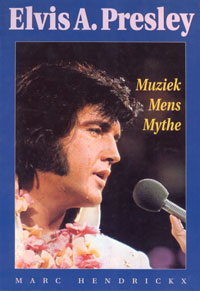
Elvis_Angel1 wrote on
April 13, 2004
Bought this book in 1998,it's has been my guide since. There is so much information there and real good pictures, bought a second copy 2 years ago, so there is one amongst my collectors items,and one next to my pc. I have 2 Elvis groups, so I use the book a lot. He did a great job, writing it, I am Dutch, and the book wasn't even expensive. If he ever writes another one about Elvis, I will be the first to get it. Sincerely Loretta from Holland
John_Burrows wrote on
May 11, 2005
I have the German "limited edition" - and I really like it very much. The book has its main focus on Elvis`career-related events and facts - and (compared with others, like the Guralnick-books) less so on his "private life". Naturally, with a book of this size, there are also some errors (mainly with respect to certain speculations about what Elvis may have recorded on one session or the other) - but nothing big as far as I can tell (and I certainly know much less about Elvis than the author). What I miss are footnotes where the sources for certain infos are presented - in cases where the info given in the book is contradicting that of other books, the reader just has the option of either believing in the author or not.
What I like MOST about the book is (no kidding) the section from 1978 to 2002. It reads somewhat like "Elvis - day by day", just that it reports and discusses all important Elvis-related events and facts for the years after his death until today. You won`t find something like this anywhere else!
While my most favorite books are still "Last train to Memphis", "Careless love", "Elvis - day by day" and "A life in music", Marc Hendrickx book "Elvis A. Presley" is the definitive "runner up" to these. It is the best "career"-related book about Elvis, and the "after death"-part has no contenders. Together with those mentioned above, I have it always within reach near my desk, so I can look things up quickly should any questions pop up while surfing in the "Elvis-World" ...